
Have you noticed how your customers search for answers today? Instead of scrolling through ten blue links, many shoppers ask ChatGPT, Gemini, or Perplexity for a quick reply. Consequently, getting your business mentioned inside these AI answers matters more than ever before. I studied the latest industry reports and real search data to map out what works next. Below are the 10 biggest trends in Generative Engine Optimization (GEO) for 2027.
What Is Generative Engine Optimization (GEO)?
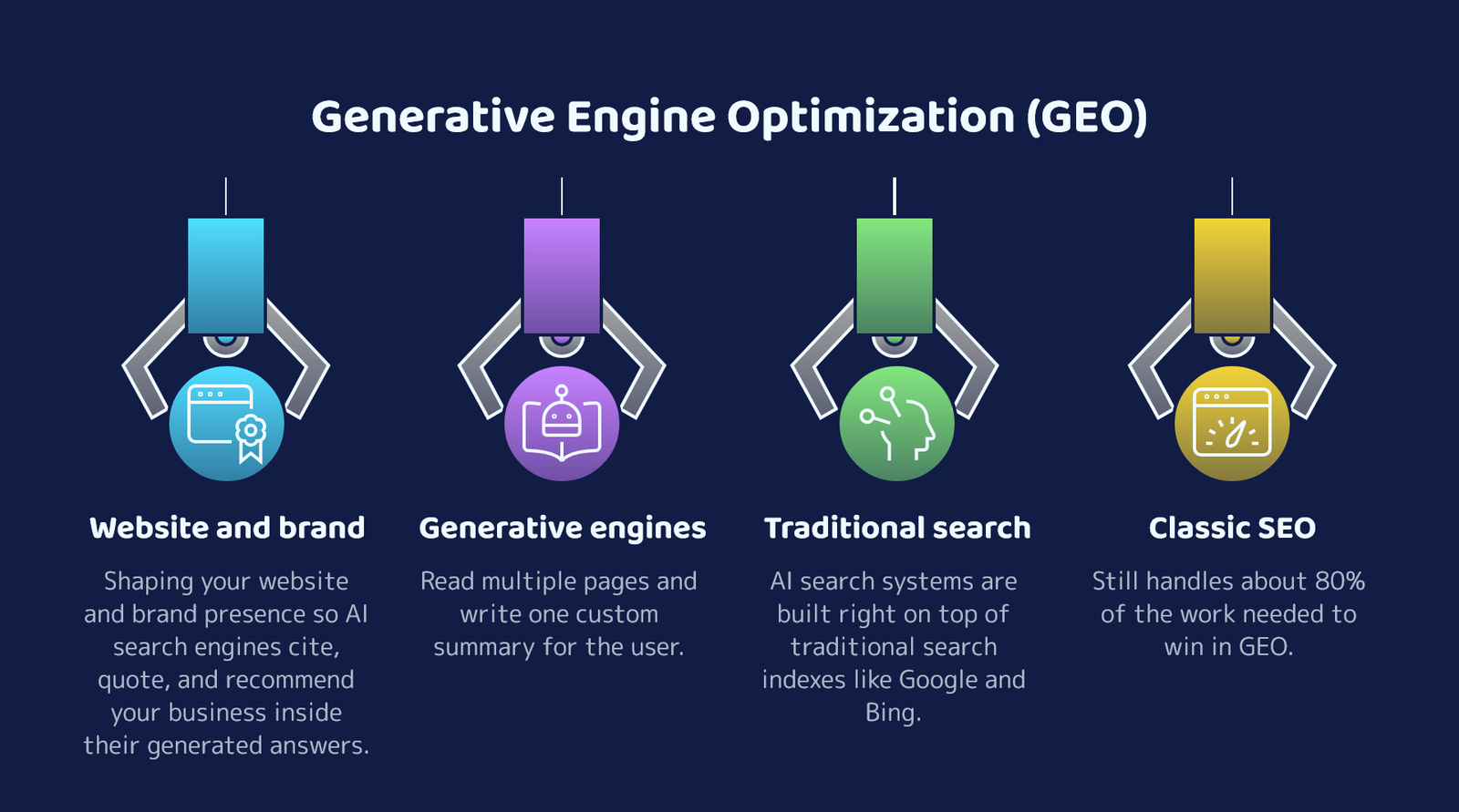 Generative Engine Optimization (GEO) is the practice of shaping your website and brand presence so AI search engines cite, quote, and recommend your business inside their generated answers.
Unlike old search engines, generative engines read multiple pages and write one custom summary for the user. However, this does not mean traditional search is dead. In fact, AI search systems are built right on top of traditional search indexes like Google and Bing. Thus, strong classic SEO still handles about 80% of the work needed to win in GEO.
1. Query Fan-Out Replaces Single-Keyword Targeting
AI search engines now break one user prompt into several hidden sub-queries at the same time to build a complete answer.
In the past, you picked one main keyword and wrote a single page for it. Today, that old habit is not enough. For example, if a buyer asks how to fix a weedy lawn, the AI model automatically searches for weed removers, natural fixes, and lawn care tips in the background. Similarly, if someone asks about installing a home charger, the engine checks costs, permits, and local installers all at once. Therefore, ranking for one broad head term no longer guarantees an AI citation. Instead, you must map out these fan-out queries and answer related follow-up questions clearly on your page.
2. Entity-First Optimization Beats Keyword Stuffing
Smart AI models now evaluate your website based on clear entities, topic depth, and real-world facts rather than repeated keyword strings.
Think of an entity as a clearly defined person, brand, product, or place. Rather than counting how many times a word appears, generative engines check how your brand connects to a wider topic. Furthermore, staying focused on one clear niche helps search engines trust your site. If a website covers random topics every week, both humans and AI bots get confused. As a result, building complete topic clusters around your core money pages is the fastest way to earn topical authority.
3. Zero-Click Search Shifts KPIs to Citations and Mentions
Zero-click searches are now the norm, forcing brands to measure AI mentions, citations, and conversions instead of raw website clicks.
When Google AI Overviews appear at the top of a page, fewer people click through to websites. Still, this shift does not ruin your business. Instead, it changes how you track success. Today, two new metrics lead every smart GEO report:
Citations: Counting how often an AI engine uses your webpage as a linked source to build its answer.
Brand Mentions: Tracking how often an AI tool explicitly recommends your company name to a buyer.
AI Share of Voice: Measuring how often your brand shows up compared to your top competitors.
Conversion Quality: Tracking leads and sales from AI visitors, since people who click from an AI answer are often ready to buy.
4. Human-First Content and Information Gain Win Citations
AI models prefer citing pages that offer fresh, first-hand human experience and original information gain rather than generic rewritten text.
Anyone can ask a chatbot to write a basic blog post in ten seconds. However, when a bot simply averages ten existing articles, it adds zero new value. Google does not penalize AI-assisted writing, yet it strictly filters out thin, spammy content. Moreover, Google’s own leaked data highlights “content effort” as a real ranking signal.
To stand out in 2027, you must publish things a machine cannot invent. For instance, share real product test results, original photos, and honest opinions from your actual client work. Additionally, build original data assets like surveys, pricing studies, and updated statistics pages. Because AI can only summarize existing facts, adding new original data forces large language models to cite your website as the source.
5. Lowering the Cost of Retrieval with Content Capsules
Websites that present clean, short answers in simple HTML lower the “cost of retrieval,” making it much cheaper and easier for AI bots to extract facts.
Running AI chats takes huge computing power. Therefore, generative engines favor pages that are fast and easy to parse. If you bury your main point inside a long, messy paragraph, the bot will skip it. Instead, use the content capsule technique. Put a clear question in your heading, and write a short, self-contained answer of 20 to 40 words right below it.
In addition, organize the rest of your page for fast scanning:
Keep paragraphs short with two or three simple sentences.
Use clean bullet points where each bullet delivers one clear fact.
Add simple comparison tables for pricing, specs, or features.
Link out to trusted primary sources whenever you share numbers or claims.
6. Off-Site Brand Mentions and Community Sentiment Drive Recommendations
AI assistants look far beyond your own website, reading customer reviews, Reddit threads, and third-party roundup lists to decide which brand to recommend.
When a shopper asks ChatGPT for the best service in their city, the engine checks what the rest of the web says about you. In fact, consensus across third-party sources heavily shapes AI answers. Thus, building a “surround sound” presence across the internet is vital.
You can strengthen your off-site signals through a few proven steps:
Earn spots in “best of” roundup articles and comparison guides in your industry.
Answer journalist requests on platforms like Connectively or Source of Sources to win trusted quotes and backlinks.
Keep your business Name, Address, and Phone number (NAP) consistent across local directories.
Encourage real customers to leave honest reviews on Google Business Profile and trusted review platforms.
7. Multimodal GEO Expands Search Beyond Plain Text
Search is no longer just about written words, as AI engines now pull answers from YouTube videos, images, audio transcripts, and visual diagrams.
We are moving from simple search engine optimization to “Search Everywhere Optimization”. For example, Google’s AI Overviews and Gemini frequently cite YouTube videos right at the top of search results. Consequently, turning one blog post into multiple content formats gives your brand a huge edge.
Start by recording short videos that explain your main services clearly on camera. Next, publish those videos on YouTube and embed them directly onto your matching service pages. Furthermore, add custom diagrams, real screenshots, and compressed WebP images with clear alt text. When you show up in text, video, and social posts at the same time, AI models see your brand everywhere.
8. Systematic Content Freshness Becomes Mandatory
AI search engines show a strong bias toward fresh, recently updated pages, meaning outdated content quickly drops out of AI answer pools.
Modern AI models update their knowledge frequently. If your article still lists old prices, broken links, or outdated screenshots, generative engines will pick a fresher competitor instead. Therefore, you should review and refresh your top pages every three months. Update your numbers, add new customer examples, and keep your “last updated” date visible. Regular updates send a clear signal that your business is active and reliable.
9. Preparing Websites for Agentic Search and AI Crawlers
In 2027, AI tools are shifting from passive answer bots into active agents that compare options, book services, and interact directly with your website.
Because AI agents need to read your site cleanly before taking action, technical clarity matters more than ever. First, check your robots.txt file to ensure you are not accidentally blocking legitimate AI crawlers. Second, keep your core content in clean HTML instead of hiding text inside heavy JavaScript or unsearchable files. Third, add clear Schema markup—such as Organization, Service, Product, and FAQ schema—so machines understand your exact offerings without guessing. Many forward-thinking sites are also adopting llms.txt files to guide AI bots directly to their most important pages.
10. Multi-Platform AI Tracking and Dedicated GEO Workflows
Because ChatGPT, Google AI Mode, Gemini, and Perplexity each cite different brands, businesses are investing in dedicated AI tracking tools and specialized workflows.
You cannot rely on Google Search Console alone anymore, since it does not track visits or mentions inside ChatGPT or Perplexity. However, you can start tracking your AI visibility today without spending a fortune. For instance, Bing Webmaster Tools offers a free AI Performance report that shows your citations and cited queries. Additionally, you can manually test your top buyer questions in incognito AI chat windows each month. As paid AI placements and sponsored citations begin to grow in 2027, brands that already track and win organic GEO will hold a massive head start.
Old SEO vs. 2027 GEO Strategy
Let us compare how search optimization has shifted from past habits to the new 2027 rules.
| Strategy Area | Traditional SEO Approach | 2027 GEO Approach |
| Primary Target | Single exact-match keywords | Broad topics, entities, and fan-out sub-queries |
| Content Style | Long introductions and generic summaries | Content capsules, original data, and first-hand experience |
| Success Metrics | Rankings and raw website clicks | AI citations, brand mentions, and conversions |
| Media Formats | Mostly written blog text | Multimodal text, YouTube video, tables, and visuals |
| Off-Site Focus | Pure backlink quantity | Trusted brand mentions, reviews, and community consensus |
| Technical Focus | Basic crawlability for Googlebot | Low cost of retrieval, rich schema, and AI agent readiness |
How to Start Your 2027 GEO Action Plan
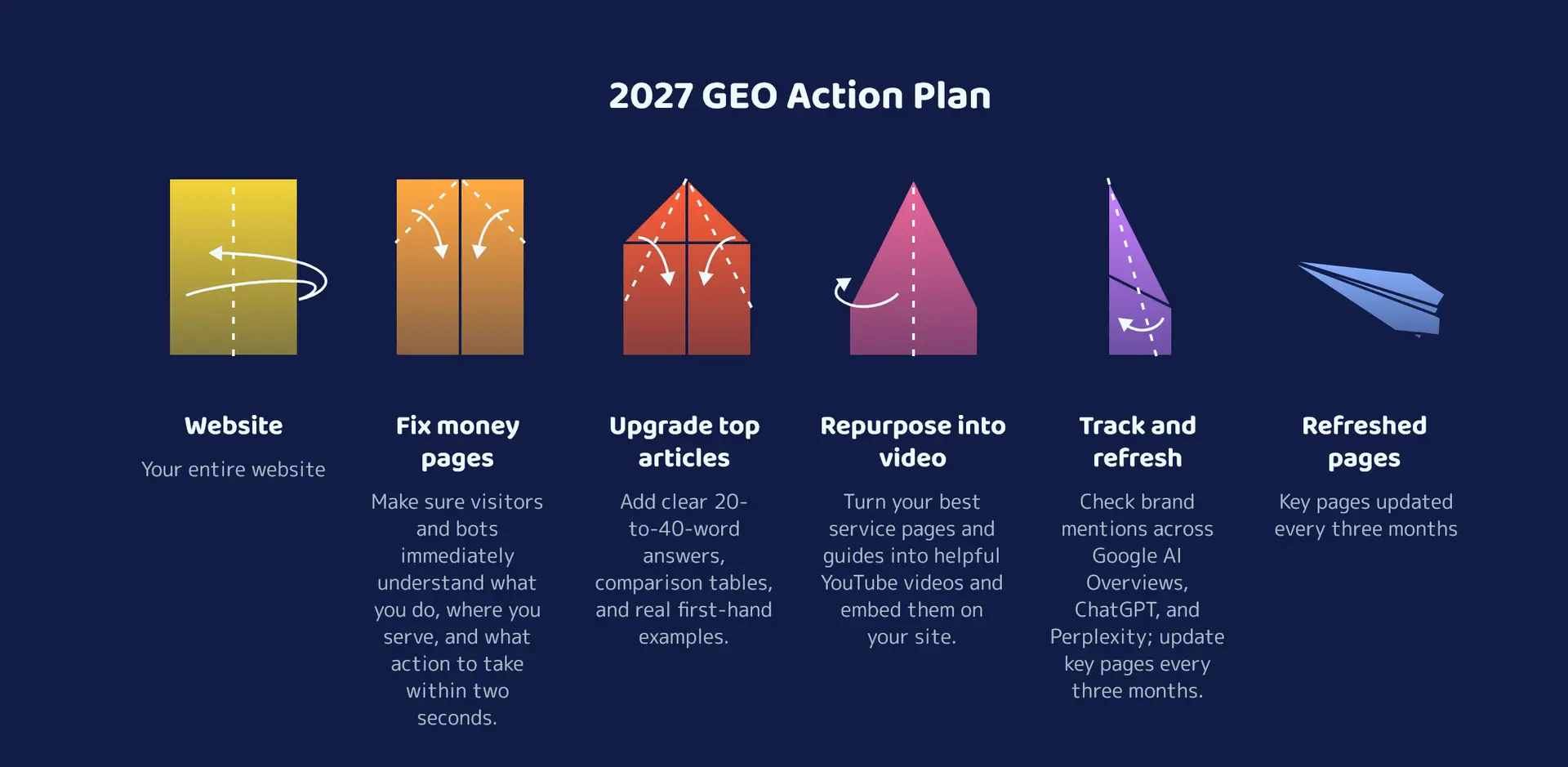
Adapting to these ten trends does not require rebuilding your entire website overnight. Instead, follow a simple step-by-step order:
Fix your core money pages first: Make sure visitors and bots immediately understand what you do, where you serve, and what action to take within two seconds.
Upgrade your top articles: Add clear 20-to-40-word answers under question headings, insert comparison tables, and include real first-hand examples.
Repurpose into video: Turn your best service pages and guides into helpful YouTube videos and embed them on your site.
Track and refresh quarterly: Check your brand mentions across Google AI Overviews, ChatGPT, and Perplexity, and update your key pages every three months.
Moving Forward with Confidence
Search is changing faster than ever, yet the core goal stays the same. You want to be the most helpful, trusted answer wherever your buyers look. By focusing on real expertise, clean structure, and strong brand signals, your business will thrive in both traditional search and AI engines. At Businessic GrowUp, we help growing brands put these exact entity-first and GEO systems into action so they never fall behind. Start with one small update to your top service page today, and build your AI visibility step by step.